21 November 2016

Betting Against the United States


Very good article on Steve Bannon.  Agree with this wholeheartedly:  "The globalists gutted the American working class and created a middle class in Asia.”  Rings true:  “In sum, the working man was betrayed by the establishment [both R and D], or what he dismisses as the "donor class."” But here’s where my cognitive dissonance kicks in.  Trump is most assuredly a globalist and a member of the donor class.  And Steve Bannon is an angry misanthrope.  

A number of years ago, a portfolio manager, an Oxford educated, upper class Brit hired to run international investments for my employer, told us at a quarterly conference that America was pretty much over, that Americans were imbued with a sense of entitlement, were thick and rather clueless, that the smart money, while still based in the US, would increasingly invest in US multinationals or internationally,  because the US’s rotting infrastructure, self-centered view of the world, expensive labor (inclusive of the professions) and lousy schools had already doomed us.  It was just a matter of time. 
This was couched in eloquent verbiage, of course, delivered with an upper class British accent.  His view was shared by the Wall Street breed of New Yorkers in the room.  It was a pessimistic and hopeless message.  Your factories were never coming back, necessary remediation of environmental contamination left behind by departed foundries and manufacturing plants would choke profits and progress, America’s day in the sun was over or about to be. 

A friend at the time, more hopeful, explained the situation to me thus:  “America will be the Kenilworth of the world (Kenilworth being an extremely wealthy suburb of Chicago), the headquarters country, the administrative center.”  And I countered with, “And the rest of the world will be Gary, Indiana?”  But – even he was wrong, because money is fluid, and, see below, there is no loyalty by big business to the United States, per se.

In looking back, I was the only person in the room of about 60 people that hailed from small town Midwest, a manufacturing center, no less.  Many of us thought the Brit was an insufferable snob, but few, if any, had witnessed, as I had (from a distance) the decline and near death of a once thriving town.  To say that I took his insults somewhat personally, well …   (So I organized a bowling outing for the whole group, including the Brit, in nearby Lake Geneva, Wisconsin, which fact did not endear me to company management, until, surprise, the exotic, expensive  Brit had a jolly, good time.) 

Here is where learned that betting against America was actually pretty good business.  And by “America” I mean – sorry – the 99.9%.  There was enough steam in the system to propel us forward for a generation without excessive reminders that the end was fast approaching, so politicians could engage in the usual partisan cant, and the country could retain its steadfast fealty to big business, because jobs, prosperity, retirement security, spreading the wealth.  But big business had no loyalty to the United States or its people (except as consumers, and well-behaved citizens guaranteeing orderly societal interactions and transfer of political power). Cheap labor, and importantly, massive new markets, offered something we cannot.  But in order to perpetuate the fiction that we must give big business everything it asks for, there had to be a few bad guys to blame for continued erosion of big business support for the US:  Taxes, unruly minorities, bad schools, government intrusion …   That’s my conclusion, anyway.

How Steve Bannon and Trump plan on redressing the wounded and substantial middle is still a mystery.  Infrastructure projects likely would be privatized and cherry-picked (much needed water infrastructure and road/bridge repairs are not profitable) and offer temporary, though lucrative, jobs in the construction industry.  Many manufacturing jobs have been replaced by a microchip or robot or simply greater efficiency.  They’re just gone.  Trade constraints will hurt agricultural exports, very big in the flyover region, and given the newly established and emergent middle classes elsewhere, perhaps foreign manufacturers will find other markets for their products.  Pipelines, etc. offer, as well, temporary employment for some, but there is the downside of more environmental degradation. For those of us who believe the scientific consensus that climate change is real and accelerated by CO2 emissions, it’s a rock and hard place solution.  On this point, I would like to be wrong, truly, because the consequences of the consensus being right are so drastic.

For about 25 years I have been pondering what will become of all the excess labor in the US.  Not everyone is endowed with a massive IQ and education to support it, not everyone is an Ivy League wonder kid with all the right social connections, eighty percent or more of startup business fail, and life happens, even to the most fortunate.  We can’t depend on casinos and golf course developments to underpin an economy, real estate development cannot supplant manufacturing as a main source of economic strength and boomer retirement wealth, the fuel for many real estate bonanzas, will run out.  (Hint:  in the short to medium term, health care providers and assisted living facilities will get the lion’s share.) Then what? 


16 July 2015

Happy Birthday, Dad!


Today would have been my father’s 100th birthday. If he were here – and who’s to say that he isn’t – he’d love turning 100, because in spite life socking it to him too many times, he was an optimist.  “The Impossible Dream” from Man of La Mancha was one of his favorite songs.

 He was born in a little town on the Illinois River where his father’s German family had settled. When he was 6 months old, they moved to Niles, Michigan, just across the state line from South Bend, back to his mother’s hometown, and he lived in Berrien County for the rest of his life, save three years in WWII. He considered himself a Niles native, though, and was an abiding Notre Dame fan to the great consternation of his offspring, who preferred Michigan and Michigan State.  While Knute Rockne was making his legacy in the 1920s, radio was the hot new medium, and the ND Fighting Irish became the first ‘America’s team’.  The school didn’t grant exclusive broadcast rights for its football games, so stations from coast to coast came to South Bend.  Guys like my dad could share in the glory.  

He was a golf caddy in his teen years, and he played the game from that time on, even as a serviceman in England during the Second World War. There he somehow got to play at a course in Henley-on-Thames.  He had kept a souvenir brochure of the town with his WWII memorabilia, and the town came up quite a bit in his WWII canon.  Usually with the Henley golf story, he’d bring up the time he and a buddy wandered onto the grounds of Windsor Castle whereupon a cordial Guard showed them the way out.  Dad was never a jerk, so his encounters with the British and Europeans during the war were recalled with delight.

There may have been a country club in Niles – I don’t know for sure – but Dad also caddied for Chicago gangsters from time to time.  I remember one caddying story featuring a hoodlum:  “Hey, kid, how d’ya get to Dow-a-guy-ack?” (Dowagiac, a town in neighboring Cass County - Natives pronounce it Do- wa’-jack.)  He wanted Dad to accompany him and serve up woods and irons. I think Dad was cautious about traveling anywhere with one of Capone’s wise guys, so he gave directions and received a generous tip anyway.  (A hood with a heart of gold) Berrien County was an open territory for rival gangsters, The Purple Gang from Detroit and Capone’s empire from Chicago, so there were mobsters everywhere while the Eighteenth Amendment was in effect.  (and afterward, as the criminal networks proved useful for other endeavors.)

Another job he had was to change the marquee of the Niles movie theater and to carry the heavy film reels up to the projection booth.  For this he may have received a small wage- probably not, because it was the early Depression years - but was allowed to watch the movies gratis.  The Marx Brothers were an absolute favorite, W. C. Fields, Laurel and Hardy, Buster Keaton.   He and my mother saw the later Marx Brothers oeuvre together.  Dad had a terrific memory and could quote Groucho for just about any occasion.  

When he was a little kid, he ventured outside for a walk and took a nap in a field accompanied by the family dog, a Collie, if I remember.   His mother found both of them, the dog keeping watch and Dad sound asleep.  She was nominated for a Carnegie medal for rescuing another of her sons from a well he’d tumbled into, but because it was her child, she didn’t qualify for the honor.

Grandma Weiss was Irish.  Totally. Niles had an Irish section, the 4th Ward, removed from the local patricians.  Because they stuck together, Dad absorbed the Irish-American cultural point of view, and his innate story-telling ability was enhanced by listening to tales of the O’Connell clan, McGee, who “didn’t have a leg under him” most of the time, the Slatterys, Aunt Mary and Red Bill.

 Dad’s mother’s cousin, Billy Casey, ran a saloon there, and he prospered.  His house still stands, a gothic  oddity probably built in the 1880s.   He was generous to my grandmother and to my dad, plying him with ham sandwiches and pie and a little money on occasion.  Billy gained a bit of posthumous recognition in a biography of Niles native and legendary sportswriter, Ring Lardner.  Lardner’s aunts received a weekly bottle of spirits delivered to their home by Billy Casey, courtesy of their famous nephew.  Mom and Dad lived in Ring Lardner’s house when they were first married, and the aunts were their landlords.  I suppose Billy Casey may have arranged for them to have that apartment.  

In 1918 dad’s grandfather, Richard O’Connell, who had come to Niles via Chicago from County Kerry in 1870, died in the flu epidemic. The family was away for an extended period visiting relatives in Illinois, and dad’s mother didn’t find out about her father’s death until months after it happened.  They had been estranged because of my grandmother’s marriage to a German Lutheran.  When she returned to Niles, she discovered that all of his property had been divided among the shirttail relatives, because those good Irish Catholics all had lied and told the probate court that she, her father’s only child, was dead.  Her lawyer petitioned to reopen the file, and she was awarded her due. Dad remembered sitting in the posh anteroom of the lawyer’s office, wood-paneled and upholstered, waiting for his mother.

 Someday I’ll have to order the probate file.  Billy Casey was one of the people who told the court my grandmother was dead.  Dad always thought that Billy’s generosity may have been partly out of guilt.

About 1928 Dad and his brother Gordon both won the spelling bee in their respective schools, Dad in the junior high and Gordon in high school, and the newspaper, The Niles Daily Star, wrote a little story about them.  He and his two brothers were plenty smart, quick witted and of good cheer.  Their father died in 1928 of a probable brain tumor, and by 1930, they lost their house and eventually all the contents, which had been placed in storage, including first editions of Charles Dickens.  As I relate these vignettes, I can’t say for sure whether the books were first editions, for example, or just really nice old books, but their loss impacted Dad and his mother both because they each had a way with words.

Dad didn’t relay his history to solicit sympathy or to shame us with tales of his hardscrabble experiences.  The Great Depression was a Major Subject for people in my father’s generation as most of my contemporaries can relate.  I probably know as much about it as I do the 60s.   Dad’s main motivation I think, aside from an opportunity to tell a story, was to pay tribute to his mother, who was a brick.  And also to zing a few hypocrites who did absolutely nothing to aid his family, even though it was in their power to do so.  Both he and my mother had a hard time, but they weren’t bitter or nasty.  Quite the opposite.  They tried to be to other people what they wished people had been to them.  

After they lost the house, Dad found a job – lucky, that – working in a hotel restaurant in Niles where he made a dollar a day plus room and board.  His mother went to live with her Aunt Mary O’Connell, who had quite a lot of money for those days, but who was close with a dollar, having been a maid on Boston’s Beacon Hill before coming to Michigan.  She lived to be 95, and her estate was worth $250,000. in 1935.  For a time Dad stayed with her, too, and every morning she went to early mass at St. Mary’s Catholic Church.  Many of those days she’d hit my father up for the offering.  “Say, Nor, you wouldn’t happen to have a dime now would you?”  One had to give the church silver coins, and dimes were still silver in the 30s.

On one of our trips to visit the landmarks of Dad’s youth in Niles, we went into St. Mary’s.  I’m not sure he’d ever actually been inside, but his Irish relatives (all except his mother, that is) were buried in the Catholic cemetery nearby.  My sister started looking over the stained glass windows and discovered that three of the large panels had been donated by Dad’ s family, his grandparents, the O’Connells, his great grandparents, the Slatterys, and by good, old Aunt Mary.  He was so touched by that serendipitous discovery, even though the Church had shunned his mother for raising little pagans outside the sway of Catholicism. 

Grandma eventually went to work for the Tyler family in Niles.  They were pretty near the top of the heap socially and materially.  She was their private secretary and Girl Friday. I think she may have acted as housekeeper for them, too, and managed their household when they went to Florida for the winter.  I remember they came to her funeral in 1964 in a chauffeured limousine.

Dad and Mother met in 1935 and were married in June, 1936.  She was in Benton Harbor, so they courted up and down US-31 in Dad’s Nash automobile.  They went to the House of David, the local movie houses and Jean Klock Park.  I think their first date may have been there.  Benton Harbor was the happenin’ town, more so than Niles or St. Joe, which were straight-laced and sober, towns which nonetheless had a fleet of rum runners during Prohibition.  

At boot camp at Ft. Leonard Wood, Missouri, at the initial assembly of the men, the officer in charge announced, “One of you has experience as a cook.  Don’t make me go back upstairs to find out who you are. ”  So Dad went to cook and baker’s school and was assigned to a medical collecting company whose commanding officer was a physician from Philadelphia whom Dad recalled with particular fondness.  He became fast friends with two company medics from Kentucky and Indiana, and they stayed in contact for the rest of their lives.  On the night of Dad’s wake in 1997, his friend from Indiana happened to call the house, not knowing that Dad had died.  My brother talked to him for a long while.   That’s the last link we had to his WWII interlude.

I might be able to write a book containing all Dad’s war stories I heard again and again through the years.  The sad thing is, I didn’t get him to write them down himself.  The War was the signal experience of his life, more even than marrying and having a family, perhaps – at least equal to those events. War does that to people.  It usurps other experiences and persists in a person’s mind and heart.   

One of his best stories concerned a General who’d broken an ankle, probably not in the line of duty.  Dad and another medic transported him through a field somewhere in Holland in pitch darkness, lost their bearings and fell, General in tow, into a garbage pit.  The next day they went to pay their respects, and the General said, “Some lousy sons-of-bitches dropped me into a garbage dump last night, and when I find out who they are, I’ll have their asses.”  

His company went into Normandy at Omaha Beach on D+4 (four days after D-Day).  He didn’t ever talk about the carnage, but he doubtless saw plenty.  After Paris was liberated in August, 1944, Dad and his company went there on a pass, and someone took their picture in front of the Arc de Triomphe  alongside a Parisian who’d insisted on acting as their host.  In Dad’s experiences the French were wonderful to the “Yanks”, and he always wanted to go back with my mother.  Of course, they would have had to swim, because my mother would not fly.

Back home Dad stayed in the food business. He worked in, managed and owned several restaurants and ended up running the food service department at Mercy Hospital in Benton Harbor.  He really loved that job, I think.  The people who worked at the hospital were a community, corny as that sounds. 

 Dad and mother joined the Twin City Players, an amateur theatre troupe that’s still going strong today.  Around the mid-50s Dad was president of the group, and they’d have meetings at our house.  I remember the names of some of the other Players:  Babe and Virgil Lewis, Marian Tiffiny, Gladys and Henry Johnson, Keitha Dasse, Marilyn Birner, Roy and Muriel Mulhagen, my mother’s sister, Donna Anderson …    I don’t know how tight a group they were, but from where I sat, it sure looked like they were having great fun.  My mother was a pretty darned good actress.  Dad knew how to run things and make it fun.  Back when I was a kid, adults were allowed to engage in adult activities, and the kids could sit quietly on the sidelines and learn something or else stay home.  I certainly participated in a boatload of activities, but the folks had their own time, as well. 

In the days following Dad’s death when we were planning the funeral, my brother heard the poem “Shifting the Sun” by Diana der-Hovanessian on Garrison Keillor’s radio show, The Writer’s Almanac.  It ends thus:
“When your father dies, say the Armenians,
your sun shifts forever
and you walk in his light.”

I was spoiled being raised in a home where the man of the house was a true gent.  He never complained about anything to speak of, was enthusiastic about the family without being overbearing, was a great chef and great wit, and he gave a damn.  He always showed up, as the saying goes.  Maybe the Greatest Generation business is a bit over the top, but it’s a generation that I think that we could learn from.  Dad had insight into people and wisdom about life.  How I miss it and him every day.


22 December 2006

Friday bird blog

OK. I know I said I wasn’t going to post anything else here.
I subscribe to a list-serv for a bird enthusiasts’ group, and it’s fun for me to receive emails about various sightings in places I know of but can't see as much as I might like.

The other day someone sighted a snowy owl at a most auspicious place – where the St. Joseph River pours into Lake Michigan. It was there that I saw six American Avocets one autumn while accompanying Arthur on a walkabout. He couldn’t stand to be on the same beach with a creature more unusual than he, so he was rude to them, and they flew. Avocets generally don’t generally come this far east, so it was a big deal for me, never having seen even one before, but I had to keep my enthusiasm in check. A pouting Corgi is a sorry sight.

The snowy owl has only one known breeding spot in the United States, that being Barrow, Alaska. They stay above the tree line unless their main menu choice, the lowly lemming, is in short supply. Lemmings reproduce early and often, but they are subject to boom and bust cycles like the oil well drillers who populate their breeding ground. Here and there on the Great Plains and Canada one can find a solitary snowy owl in winter. There have been notable incursions into the lower 48, but they still are a rare sight for most of us.

If, for example, someone like Arthur were to happen upon snowy owl young, the adults would show his Corgi highness what rude is all about. The female, who is the larger of the sexes, weighs about five pounds and her wingspan is about six feet. Those talons are plenty sharp, and she is fearless, searching the wolf-dominated tundra for provisions, never straying far from the ground.  Spooking an Avocet is one thing.  An encounter with a Snowy Owl Mama is quite another.

The blue skies photo here is from an Audubon chapter in the northeastern lower peninsula of Michigan, not far from Alpena. They’re also near the world’s only nesting territory for the Kirtland’s warbler, formerly known as the Jack Pine warbler.

http://kirtlandswarbleraudubon.org/

03 November 2006

Friday Bird Blog


Being a 365 days per year walker of shores yields much bounty, most all of it pacifying and inspiring. Today, however, I have sad news to tell. Traveling along the expansive beach at Grand Mere State Park, I found two dead great blue herons, an adult and a juvenile. They had been shot.

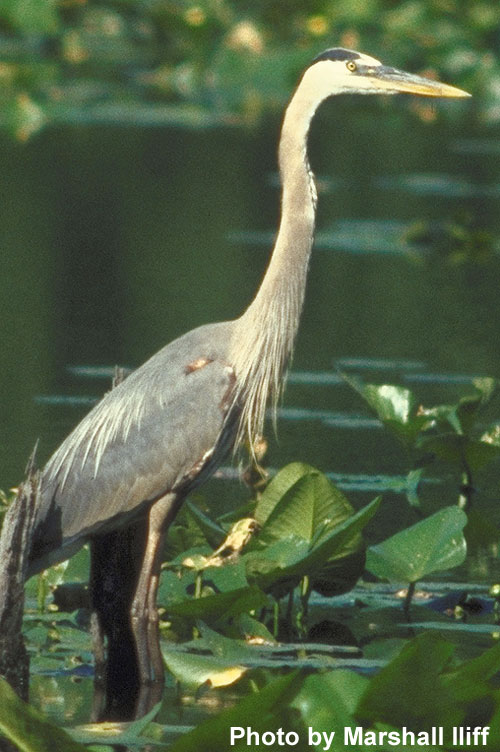
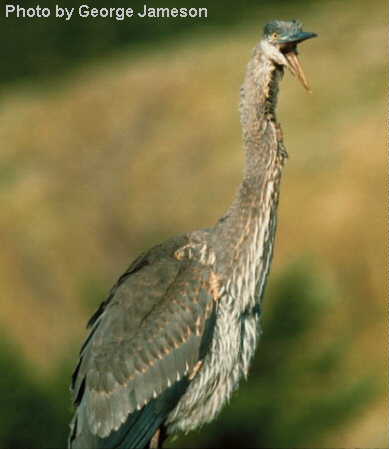
The Great Blue is a magnificent bird, a friendly giant of the Great Lakes waterways, graceful and remarkable for its blue legs. The other giant is the Sand Hill Crane, which flies with its neck extended, where the Great Blue holds his close to its body in flight. That's the way I was taught to tell them apart at a distance.

Grand Mere is a wonderful 1200 acre reserve with giant dunes and woods and a passage to the shoreline which one can travel for several miles. The Cook nuclear plant is the southern-most limit. Unfortunately, hunting begins in late September, and as far as I can tell, hunters can shoot in any part of the park. You'd have to be pretty drunk or blind to mistake a heron for a duck, and killing a juvenile may be against the law. I do know that there is no open season on herons, and I'm pretty sure that shooting something along the Lake Michigan shoreline is verboten.

Some stupid kid or crazed testosterone poisoned jerk killed these birds. One day earlier this fall, I was entering the wooded part of one of the trails, and ahead of me was a fat, lumbering hunter with a shot gun slung over his shoulder, looking like Elmer Fudd, except he was wearing a neon orange stocking cap. I retreated and called the local police not realizing that it was A-OK for him to shoot at will. There were and are no signs advising mere walkers and bird watchers to wear red or orange clothing. It's nuts. but the Michigan DNR is very pre-occupied with revenue, and hunters' license fees must add up.

There are spent orange shotgun shells littering the woods, and no park rangers are present a lot of the time.  Park management is haphazard.  Michigan used to be a most intelligent state regarding its landscape and resources.  If hunting and park uses were combined, there would have been signs advising the public of the facts and probably segregated sections set off  for each.  It's jarring to observe what has happened to Michigan which once understood the importance of keeping up appearances.  More than once I've encountered people from out of state who are spending money in hotels and restaurants and gas stations in the area and have chosen the spot because of the proximity to the lake and ample public access.  If Michigan wants tourist dollars, a few simple improvements to the lakefront parks would reinforce the state's commitment to making outsiders feel welcome.

15 October 2006

Hawkeyes


Iowa City is a most pleasant place. Really. Home to the University of Iowa, its intelligence is in evidence everywhere.  The University boasts the largest teaching hospital in the United States. There is wonderful original art in all of the State facilities, including the University properties.  Downtown offers artsy amenities in view of the state capitol's shining golden dome. 

Today we drove to a University park, the Macbride Nature Recreation Area, which hosts a raptor safe habitat for injured birds which cannot survive in the wild.

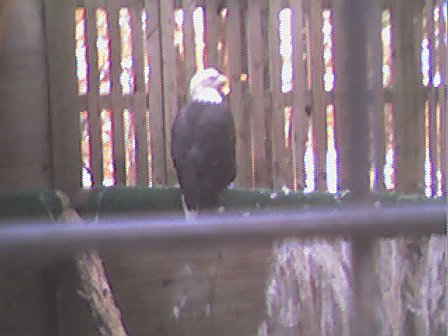
Here is Spirit, a bald eagle, who has been there for 16 years. She was found in Minnesota. Her house is cozy, with a great view.

A Saw whet owl was a resident, too, the cutest thing I've ever seen. Several hawks, other owls, including a bard owl named Cyprus, have separate cabins. Even blind birds live there. All have benefactor people or institutions.  The Macbride Raptor Project was founded in 1985 under the joint auspices of Kirkwood Community College and the University of Iowa.

08 October 2006

Two hours apart


Trekking around the bottom tip of Lake Michigan in opposition to the recreating hoards, I find myself smack dab in the middle of a beautiful, practically perfect slice of autumn.  It's the day of the Chicago Marathon, though the crowds have moved on.  October in Chicago can be ...  exquisite.

20 September 2006

Yesterday


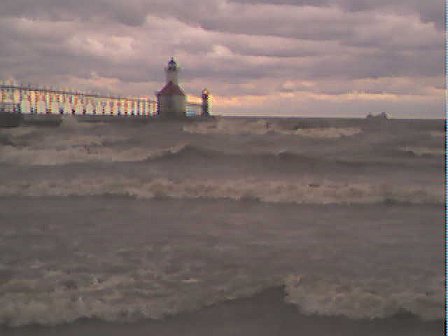
We're experiencing October in September this week. A stiff breeze swept the lake into whitecaps and threw sand in our eyes. Undeterred we walked down to the shore to spy any birds who might like their picture taken and to see of the lake had produced any treasures.


I love the lake 365 days a year. Still, clammy ninety-degree heat is problematic, and extreme cold and wind make you glad you own longjohns and fat mittens, but they won't keep me away.

15 September 2006

RAM tough


I enjoy feeling cranky once in a while. Today has given me several opportunities to indulge. It’s not exactly one of “those” days, but a heavy offering of Me-Me-Me!! Syndrome has presented itself.

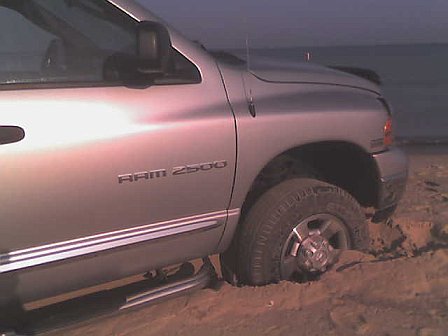
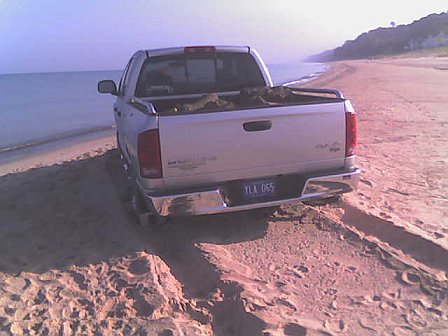
First off, I’d like to thank the sophomoric master of the universe who drove his truck onto the beach, first traversing its length in between the road and the lake and then going for it, grinding all the gears (except the ones in his head) in a muscular push to motor it along the shoreline. Behold the result.

Moneyed beach combers informed us that four years ago a brand new $80,000. Hummer and its owner found themselves in similar straights. Fortune smiled upon them in that instance, because beachcomber’s husband propelled his old time Hummer onto the sand and pulled the $80,000. Hummer team out of the drink. They actually went all the way into the water.
Ha ha. Are you laughing yet?

(There is a squiggly red line under the second ‘ha’. That’s annoying me, too.)
Second, my gratitude extends to the six (6) females departing the caffe with two f’s, who allowed me to hold open the door for them with nary a peep of thanks.


Last, I'd like to recognize the Mercedes SUV which awaited my removal of myself and my car from a desirable parking space. The driver - license plate ‘Funzini’ - grew impatient at my needless, seconds-long stowing of my purse and laptop and gunned the accelerator in disgust.

Just then I felt an urge to dust the dashboard and powder my nose. She screetched her vehicle around the corner on 2 1/2 wheels while failing to heed the stop sign, blazing past the retirement hotel in a cloud of diesel
fuel searching for another slot.


It’s Friday on the sunset coast.

Friday bird blog


Meet Mrs. Mallard Duck, mistress of the North Lake, an adorable pond, where she apparently lives by herself, except for frogs, herons and other passers-by. She greets everyone with uninterrupted quacking, paddling all through the reeds and lily pads, commenting on affairs of the day and night with an occasional dip to grab a snack.

Here she waddled out of the pond to get a closer look at me. It would have been bad manners to come to me straight away, so she groomed herself for about 10 minutes, ignoring me and my camera. She must have many callers, because she didn’t hesitate one bit before emerging from the water. Her regulars most surely bring her gifts and goodies. I had only friendly chit chat to offer.

As a rule the female mallards I have observed are hard working and harried, managing multiple ducklings in their care while the males are off in a group smoking cigars and quaffing cognac. Per haps the guardian of North Lake sent her mate packing. The kids were nowhere in sight. All grown up.

03 September 2006

Has our advertising been outsourced?


Target says this is Franklin Roosevelt. Who are we to disagree?

03 August 2006

Storm watch


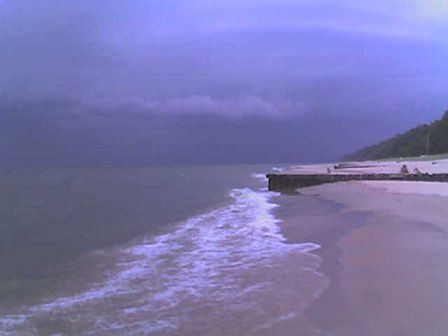
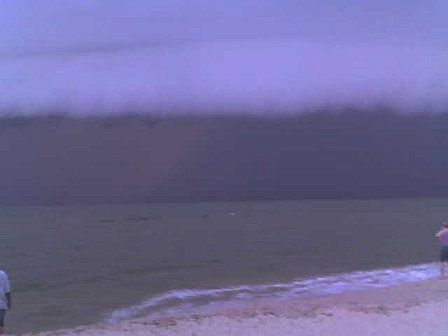
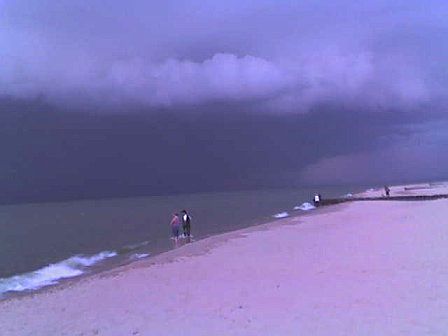
Last night it rumbled for hours here on the east side of Lake Michigan. The heat broke close to 9 pm to everyone's relief. Then the rain commenced. Sheets of it. I sat in a parking lot of a store waiting for a break. Finally I took my shoes off, grabbed a towel and swam to the door. Then I went to see the latest Pirates of the Caribbean which I know nothing about.  We lost power to constant lightning and thunder. A couple of sky-splitters kept us awake.  This was a very picturesque storm with memorable sound effects.

24 March 2006

Friday bird blog

Western woodpeckers color plate from A Field Guide to Western Birds by Roger Tory Peterson

Bird sightings reported to hotlines, cooperative extensions and nature centers tend to be exotics. The friendly birds who habituate my feeders might resent this just a tad, because they are faithful and reliable, just so long as the feeders aren’t overlooked too often. A lapse or two in dispensing our special house blend is forgiven pretty quickly. Cats minding the store are another matter altogether. Even friends have limits.

This week – maybe I should start these columns, “It’s been a slow week in …”. All the men are definitely not good-looking, however. Nix that idea. But this week, the snowy owls still are around the southern lower peninsula, Ross’ geese appear here and there on Lake Michigan, there’s a varied thrush in a very improbable spot in Muskegon County, and this week’s feature bird is the Black-backed woodpecker, a/k/a the artic three-toed woodpecker, here from the northwestern US or Canada.

I’m assuming it’s a male present in Dickinson County, which is in the UP, site of Iron Mountain and many mining towns of the late 19th Century. The black-backed woodpecker – I guess that’s his official name now – is a resident of evergreens in the high mountains of Canada and west in the US to Montana and Wyoming. Iron Mountain is a piddly hill compared to the Sierras, but when one is w-a-y off base, so to speak, one must compensate like mad.
Black-backed woodpecker, male
Dickinson County, Michigan was a minor “fever” spot in the late 1870s when iron ore was discovered. One of the town patricians of Niles, Michigan, where my father grew up, was Henry Austin Chapin, a dry goods store proprietor until his 40 acres in Dickinson County yielded a lot of lucrative mineral deposits. (“Then one day he was shootin’ at some food, And up through the ground came a bubblin’ crude.”)

The family had built a mansion which was near where my father’s family resided, though not nearly so splendidly. In 1933, the depth of the Great Depression, the Chapin family sold the house to the city of Niles for $300. at auction. Today it houses City Hall.


21 March 2006

A true Victorian lady


This day was my grandmother’s birthday. She was the matriarch of the entire family and still is, actually, even though she died in 1956. Everyone loved her, even the in-laws. Her children and their spouses didn’t analyze their parents as much as we do in my generation, but she would have stood up, regardless. My parents’ generation is all gone now, too, and my generation does not get on too well, but we all have Grandma as a lodestar.

She was of solid Yankee Protestant stock, particularly influenced by the values of the Congregational Church, like one founded by her ancestor, William Kelsey, in 1650s Connecticut. He and others of the Braintree Company removed from New Towne (later Cambridge, Massachusetts) to a spot (later Hartford) on the Connecticut River in 1635, as part of an advance team for their leader, Thomas Hooker. It is thought that the term “Yankee” was coined by the Dutch already present when William’s little band arrived on the scene from the Dutch word for “squatter” or “thief”, so he might have been among the original “Yankees”. (Demystifies it all a bit, eh?) It sounds so smug, but if ever there was an example of stalwart Yankee virtue, it was my grandmother.

Grandma probably never knew all the genealogy that I’ve dug up, although her name appears in the 4 volume Kelsey genealogy begun in the 19th Century, under the guidance of Edward Claypool, who was a prominent genealogist. Many of the stories I’d heard about names and places have turned out to be accurate, and those stories undoubtedly came from her. A Victorian through and through, she never would have called attention to herself, though. When my sister received a pretty sweater for Christmas and commented that she’d be the best dressed girl in school, Grandma remonstrated with her, because that was boastful and common. One showed one’s breeding by what one didn’t say, I suppose.

To this day, I cannot slouch in a chair. That is part of her legacy. Lazy posture was akin to moral turpitude.  Likewise, whining, rudeness, cutting corners - - all verboten. 

She was influential because she was selfless, stoic, loyal and kind. We tend to aggrandize the dear departed, but character was significant. Doing the right thing, being of service, doing a job the best one could even though no one else might ever know. All these things were expected, de rigueur, standard.

Growing up with benchmarks like those has its pitfalls. The rest of the world doesn’t operate according to Grandma’s strictures. She was a product of pioneer Protestants and Progressives, though, not swindlers and conmen, and she behaved like an aristocrat, even though she was far removed from their company.

Her name was Beatrice Hortense, a very fashionable name for 1889, the year she was born. Her mother, Marjorie Copper Kelsey, ceased naming her children after grandparents and great grandparents, choosing Albert and Blanche, as well, instead of Sarah, William or the Old Testament names adopted by their Puritan ancestors, like Moses, Zachariah and Rachel, all names in my ancestry. She must have been quite modern, possibly a consequence of life on the pioneer trail to Nebraska.

Grandma would be agog at the world today, disapproving of our lack of discipline and capitulation to materialism. Her world was hardly perfect, though, and she suffered many hardships and disappointments, but she wished for her children and grandchildren to have a better life, not necessarily one of wealth or fame, but one to make a difference even in small ways. Isn’t that what family values are all about?

17 March 2006

Friday Bird Blog

©National Geographic Society
female long-tailed duck with 7 eggs
photographed on St. Mary Islands, Quebec

Despite snow and ice, there is abundant sun here. Earlier this week, Monday and Tuesday, I believe it was, the sun was brilliant all day long. After days of gloom and fog, it feels like life is returning. Today we’ll have fairyland for a while – the trees and bushes look like they’re sugar-coated – but after a few hours of sunshine, it’ll be gone. Time for spring!

Dawn now features noisy chattering from the feathered crowd. On Sunday and Monday it was in the mid-60’s, and the robin was in full voice, notifying us of the coming rain. Rain it did.

The Michigan statewide bird report dutifully recorded each Thursday night, this week features 3900+ long-tailed ducks, formerly called oldsquaw, along Lake Michigan in Allegan County, site of many a bird walk in my days of youth. The duck’s official name was changed to conform to British nomenclature. As well, the U.S. Fish and Wildlife Service in Alaska petitioned the American Ornithologist’s Union to change the name, potentially offensive, because the bird’s declining numbers in Alaska would require cooperation from Native Americans to sustain the population.

The sand hill cranes ought to be making an appearance soon. They were like old friends on the little lake where we lived when I was very young. My mother taught me how to identify cranes and herons in flight when I was maybe three years old. I was a font of wisdom, knew the black-billed cuckoo from the yellow-billed, the cedar waxwing from the Bohemian. When you grow up with this stuff it doesn’t seem difficult at all, and, of course, a child’s impressions are so strong and clear, not muddled and over-wrought.

We have a serious robin invasion, lots of squabbles over territory. Time to put out pieces of string and hair, although robins will use just about anything to construct a domicile. Maybe I should have a contest for the most original nest.

03 March 2006

Friday bird blog

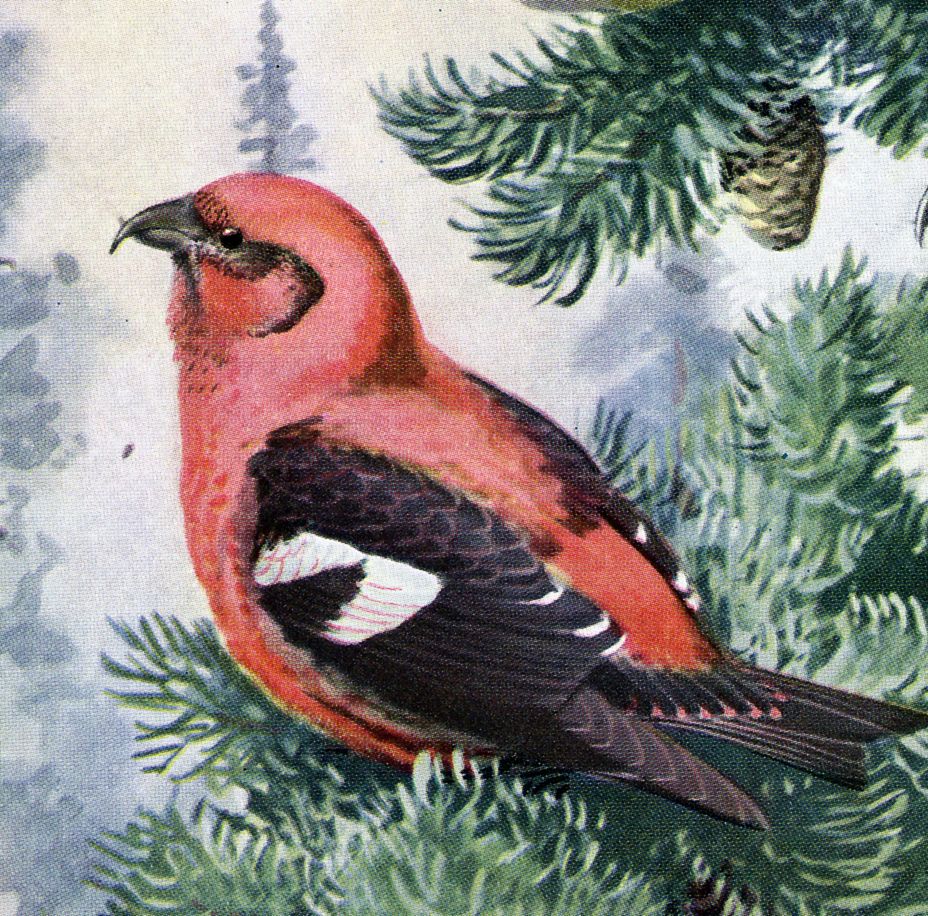
White winged crossbill
Illustration by Louis Agassiz Fuertes

Despite endless turmoil and uncertainty in the homosapien world, the birds appear unaffected. Two days ago I spied my first robin hopping about, plotting a settlement for the coming three-nester. This morning Mr. Mourning Dove was pursuing Mrs. (or Miss – can never be quite sure) Dove, puffing himself up and trying to jump her, to put an accurate spin on the scene. Crude, but nature never appropriated Victorian sensibilities.

The juncos are faithful, as are the downy woodpeckers, an occasional red-headed woodpecker, the titmice, which I love – cousin to the chickadee - how could they not be adorable – red-breasted and white-breasted nuthatches, the cardinal and blue jays, and ever-watchful crows, awaiting leftover popcorn. I made my own birdseed mix this winter, because I had lots of stale peanuts I’d bought in bulk on sale really cheap last year to make something or other and never got around to it. The can is empty, though. ‘Must restock.

It’s cold now here in Michigan. We have had little snow, though, in two months, and the tulips and narcissus are peeking through the ground. I went out the other day and cut through the landscape cloth I put down last fall, because I forgot to move a patch of daffodils. The ultimate effect will be more natural, which is what I always strive for, anyway.

The Michigan statewide bird report for yesterday mentions lots of owls again, a Bullock’s Oriole in Livingston County, which is in the southeastern quadrant of the lower peninsula, and a white-winged crossbill in Kent County, which is where Grand Rapids is located, home of Gerald Ford and where closed on Sunday has been a tradition ever since I can remember. Get the picture?

The Bullock ’s oriole is a western species and in any event is a summer bird in these parts, rarity though he may be at all times. What in the world is he doing at a feeder in Michigan in early March? Crazy weather patterns would be my guess.

The crossbill dips down from his winter range when food is scarce or the supply is running out or in extremely cold winters, which this has not been. According to the report he is chowing on the seeds in a mixed spruce and pine stand. Usually they travel in flocks, so next week we may hear of more.

25 February 2006

Argument for a professional military


A light entry into United States military history:

"By an Act of the Legislature, approved in April, 1841, it was required that the several battalions of State Militia should rendezvous for inspection, drill, service and martial exercise, in each county, between the first days of May and November of each year.
…

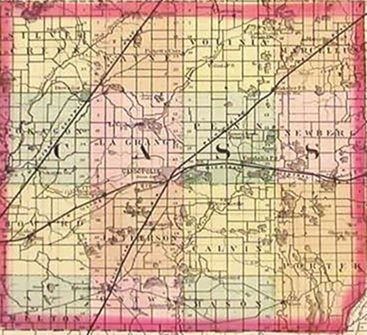
Pursuant to this, in the latter part of October, 1842, all the able bodied white male citizens of Cass County between the ages of eighteen and forty-five, were notified to rendezvous at Cassopolis for the purposes set forth in the Act.

The day proved exceedingly unfavorable, being cold and inclement with a mingled fall of rain and snow. Still, nearly one thousand sturdy yeomen assembled on the public square to receive their first lessons in the art of national defense.

They were as motley a crew as ever perplexed a drill sergeant, with shoes and without, with coats and hats, or without either. Some of them armed with rifles and shot guns, but the majority with clubs, broom-sticks and cornstalks. There was nothing uniform about them – excepting variety.

…

The “martial exercise” developed into the broadest burlesque on the art of war, and its glaring absurdity was evident to officers and men alike.

The instructors proving totally unqualified to teach, and the pupils soon being in no mood to receive instructions, resort was had to an exercise in which honors were easy and responsibilities equal.

Informal, but effective requisitions being made upon the officers, whiskey in barrels was rolled out on the public square and each Captain required to provide a pail and tin cups for the use of his Company.

The fun soon grew fast and furious. Friendly wrestling gave place to bellicose fisticuffs. Political and neighborhood quarrels were put in a way for adjustment, bloody noses and cracked crowns became the order of the day, and the first and only military training in the history of Cass County terminated in general debauch.”

From History of Cass County, Michigan from 1825 to 1875 by Howard Rogers (published 1875)

There are many county histories like this one available. The early westward pioneers were dying, and enterprising historians began to collect their stories, as well as the history of the towns and counties they’d founded in order to commemorate the nation’s Centennial. People were tremendously proud and were much closer to the history of the United States and its founding.


 A great-grat grandfather, Abner Kelsey, was part of this rendezvous of Michigan militia.  He made his way to California twice during the Gold Rush, and one of his sons settled in Tulare County where he opened a butcher shop.  Two other sons fought in the Civil War, and one, John, was killed.  It may be that the other son fought for the Confederacy, though I have yet to confirm.  Abner was an early Michigan settler, though the whole family apparently had wanderlust.  I can't imagine traveling all the way to California from the Midwest in the 1840s- twice.  Amazing.

08 February 2006

Spring songs

Illustration by Allan Brooks
About this time of year I start listening for the cardinal on sunny mornings. He is readying his claim to a nesting territory and impressing the ladies. It is one of the most beautiful sounds in nature for those of us who might have cabin fever or snow fatigue. This year (so far – always must qualify in the unpredictable Midwest) winter has been modest, so perhaps we can expect a timely spring. Another possibility is a cold May followed by a 90-degree June. Still, the memory of warm breezes scattering the apple blossoms on the orchard floor and morel mushrooms sprouting up after a rain invites even skeptics to imagine a joyous rebirth.

This a.m. I did hear not only Mr. Cardinal but a robin in the distance. He no doubt is a year round resident, as fewer robins migrate than they used to. However, we’ll take his song, even if it means he’s just in from a nearby woods.

In Michigan there is a tempest in the state legislature over the state bird. It has been the robin from the beginning. Others advocate for the Jack Pine, or Kirtland’s, warbler because its only nesting ground on the entire planet is the scrub pine lands in the north central region of the lower peninsula. Still others are pushing for the chickadee. It takes a cold heart to reject a chickadee.

Predictably, the grumpy among the elected representatives claim that the state has more important business to attend to. That position is guaranteed not to stir controversy.

05 February 2006

Studying seed catalogs


We’re back to winter in the old Midwest. January was like March. My parsley was still green, my volunteer bachelor’s buttons were healthy looking, cabbage plantlings I’d put in and forgotten about were still alive. Without any snow cover, if the temperature had been normal, they’d have been iced. Snow is a wonderful insulator, and I believe the soil is still moisture deficient, although there was quite a lot of rain in November.

It’s blustery outside and the type of winter evening seed catalog merchants count on to boost sales. Even though I am likely to be a transient once again this summer, I am damned well going to have some plants – somewhere. I love seed catalogs. Select Seeds in Union, Connecticut for heirloom flowers, Cook’s Garden Seeds, Johnny’s Selected Seeds in Albion, Maine and Seeds of Change in New Mexico fro vegetables are my favorites. Shepherd’s used to have wonderful seeds, as well, but I believe they were acquired by the White Flower Farm and then deep-sixed. They never disappointed me. Burpee’s is always reliable, too.

If I had my way, I’d turn my front yard, if possible, into a space to grow edible crops, as well as the back. At the very least native plants would take the place of some of the turf grass. I’d leave some dandelions, although I have a dandy tool with which to dig them out. The bees need the early pollen, starting with crocuses. When they’re spent, there can be a lag before the really good stuff blooms.

For several years I have dreamed of buying some land for a market garden. A handy water source and excellent soil fertility, sun (natch) are all I ask. Farm land around here runs around $5000. per acre. Agriland that’s been Dowed and Monsantoed is easy to come by, but I want land that hasn’t been wrecked by chemicals. My late uncle’s assisted living facility was built on an old orchard. Last June I walked around the property and found German Chamomile growing everywhere. Those old fashioned farmers knew what they were doing. There isn’t much of anything that German chamomile won’t help, because it attracts beneficial insects. I’m sure the farmer sprayed the trees, but the soil might not be as compromised.

Incorporated areas nearly always have restrictions on the type of dwelling one can situate on his land. Consequently I may have to go away from civilization and into fundie/survivalist country. They might appreciate someone like me. Who knows? What’s the name of that book? Oh, yes. Jesus Land. Well, that was Indiana. World of difference between Michigan and Indiana. (apologies to any I may have offended. Indiana is beautiful and the birthplace of Abraham Lincoln. I’ve been there.)

For the immediate future I may stick to hybrid tomatoes. The heirlooms need excellent soil conditions, and some don’t yield nearly as well as the hybrids. The last two years I grew a rare heirloom, red calabash, which I bought from Seeds of Change. It is prolific, but small, about twice the size of a good size cherry tomato, but does not hold too awfully long on the vine. My purple Cherokee did nothing last year, but I think the soil is the reason. Marmande, a 6 ounce heirloom, was also good.

Among the F1 hybrids, Juliet is a definite winner – prolific and good tasting. I ate dozens right off the vine. Nothing like a sun-warmed tomato. It is a plum variety.
The best all-around hybrid for my neck of the woods is Better Boy (Burpee). It is great for canning, eating, has a good shelf life and is very tasty.

A neighbor wants me to find him some certified Rutgers seed. Rutgers is a parent of the tomato Cambell’s soup uses. My brother always grows them. If I had a large enough space I could experiment.

There is something wonderful about being able to grow some of one’s own food. Work never runs out, but the effort is worth it, especially if you can preserve something for winter. Home canned tomatoes over pasta with a little Parmesan cheese is a divine concoction. My parents used to give me home canned tomatoes for Christmas. As good as a bottle of Champagne – better – and I am a Champagne girl.

There was an organic herb farm for sale around here a few years back. It was one of my favorite businesses in these parts, and they even had a little lunchtime restaurant. The proprietors’ children didn’t want to carry on the business, so they had it on the market for about $550,000. They worked seven days a week about 10 months a year, but it was spectacular. Heaven.

Well, I am bookmarking sources. Michigan has a land use institute. The cooperative extensions also can be good resources. I have one of Eliot Coleman’s books. Who knows. One of my ancestors – a great great grandmother, I believe - walked to market a couple of miles each way when she was in her ‘80s. Many such lived to be 100. My heart is in the city, but owning land is a big deal to me. Irish. Wasn’t that what Scarlett’s father told her?

27 January 2006

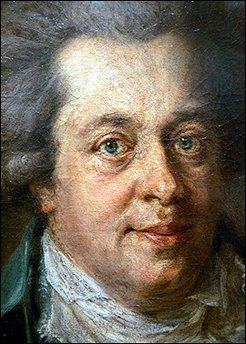
Happy Birthday, Wolfgang!


There is a God. For all the tragedy and senseless waste cluttering history, every so often beauty and genius are aligned. Mozart didn't have an easy life, but his short time here left us with evidence of the sublime, which lives beyond our quotidian understanding. What a magnificent gift.

23 January 2006

Apologetic make-up bird blog

Illustrations, Louis Aggasiz Fuertes

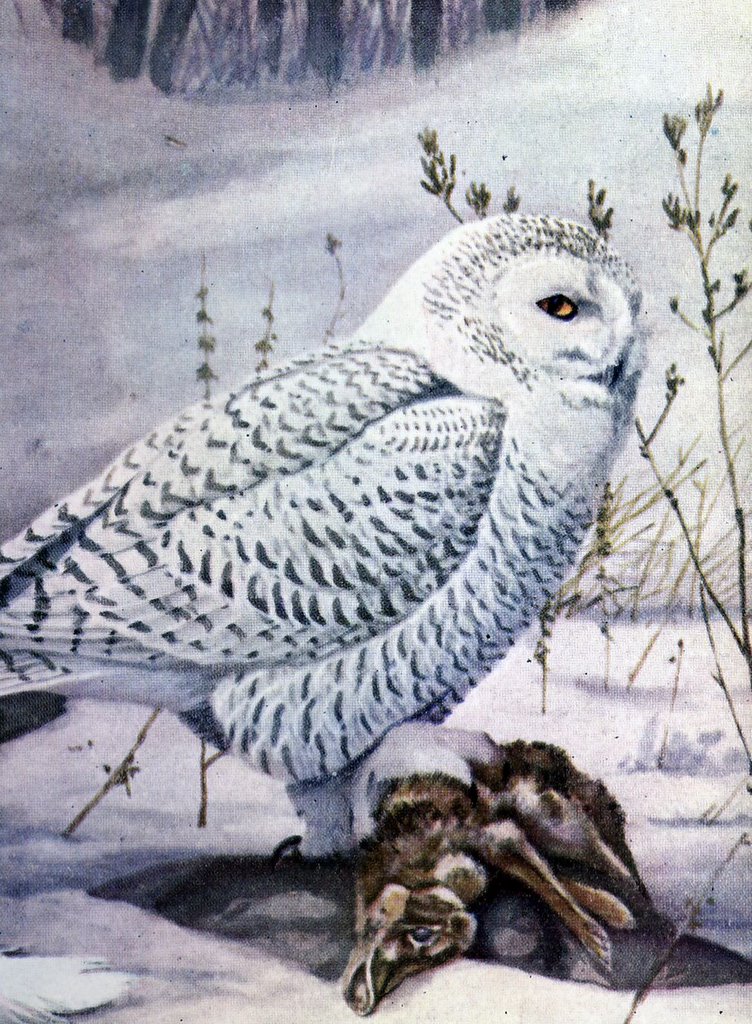
Mrs. Snowy Owl is diurnal which means she hunts during the daylight hours. She doesn’t say much from her winter perch which will be found close to the ground where the mice are. The snowy owl saves its talk for its breeding grounds in the Artic tundra. Every year a few dip down into the Great Lakes and Cape Cod.

They have the longest wing span of any North American owl and tip the scales at 3.5 pounds on average. Mouse must be fattening, because Charles the cat’s vet observed that he hadn’t missed many meals, and he has an outside gig featuring frequent mouse dinners.

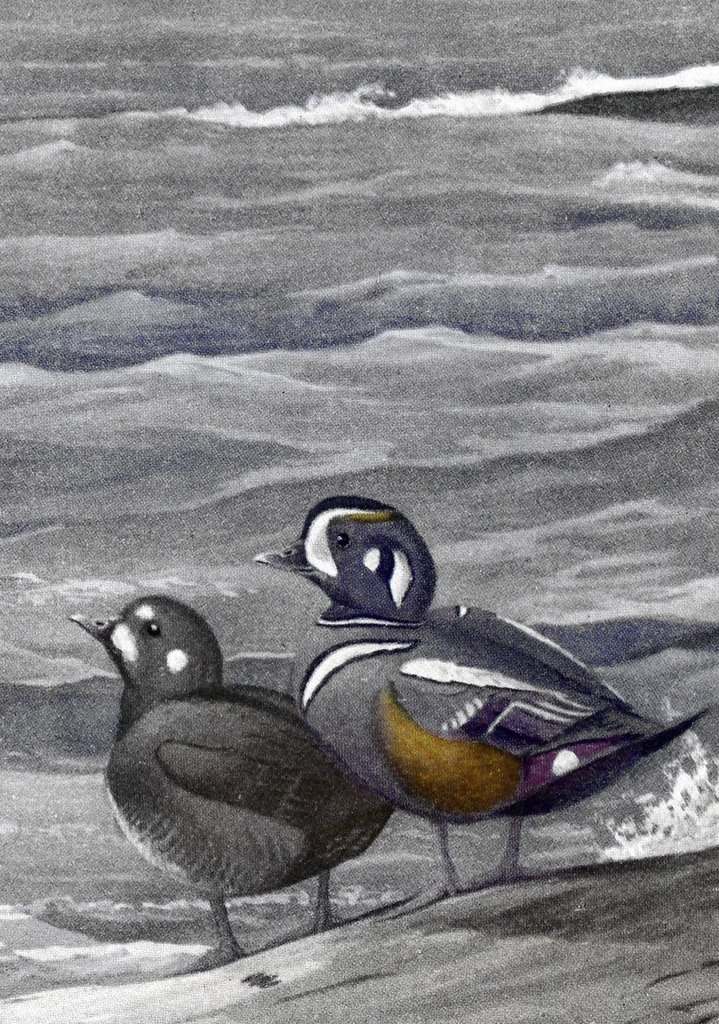
The Michigan statewide bird report for the last three weeks has chronicled snowy owls all over the state. I haven’t heard of the Willet again, but there’s a varied thrush (the robin’s family) in Manistee County, which is in the northern half of the lower peninsula, and male and female Harlequin ducks near me, so I’d better get over there to see if I can’t spot them.