Friday, November 18, 2005

Friday Bird Blog

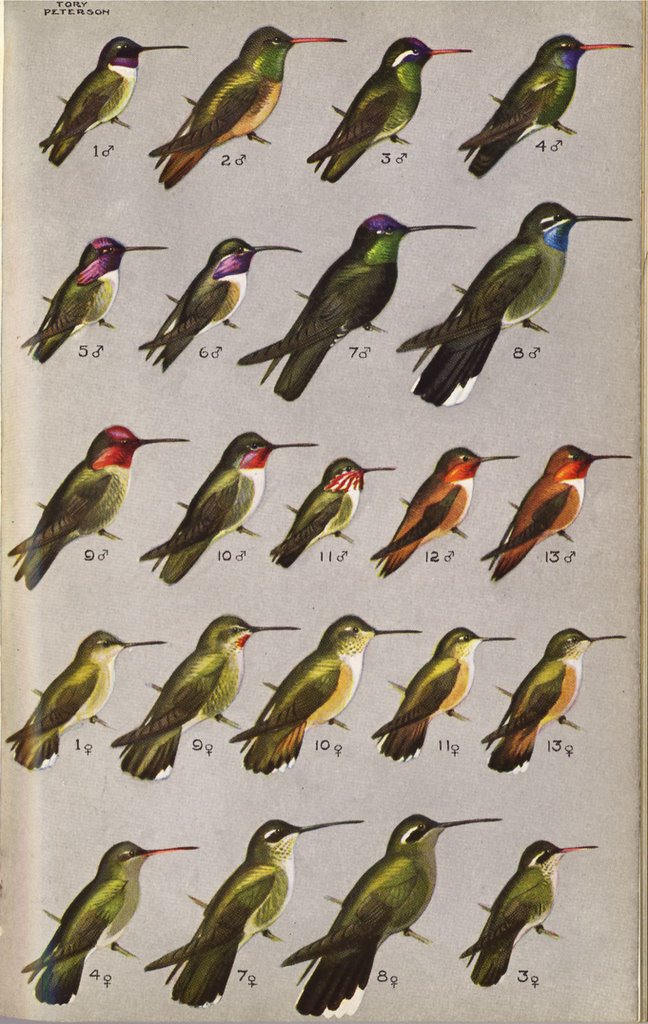
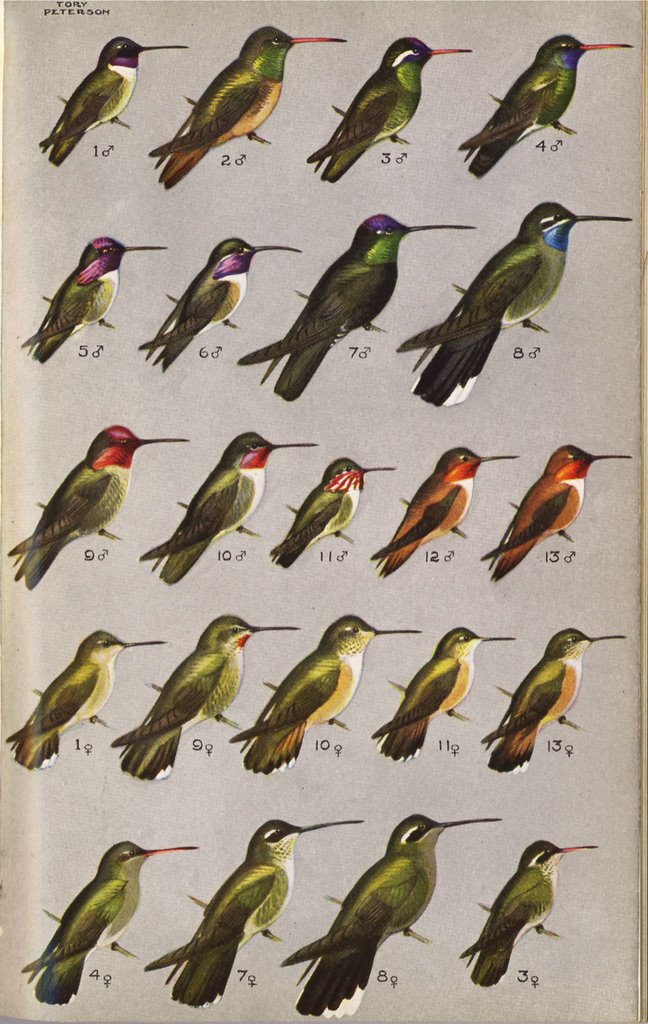
Western Hummingbirds
A plate from A Field Guide to Western Birds.
Illustrations by
Roger Tory Peterson

On Thursdays when I remember to do it I call the Michigan Statewide Bird Report hotline to see what unusual sightings people have called in during the past week. Yesterday’s report had the following:

In Livingston County, an immature Rufous Hummingbird has been hanging out at a home birdfeeder in the town of Brighton. At least he still was there on November 16. Birders are welcome to park sensibly and go around to the back yard where the feeder is. (Does this sound like A Prairie Home Companion?)

The Rufous Hummingbird is a native of the western United States, but there are occasional, but still rare, sightings in the Midwest. As a rule of thumb all hummingbird feeders should be taken down in late August or early September in places where the winter means business. Several years ago in Wisconsin, a Rufous Hummingbird was taken captive by the Milwaukee Mitchell Park Conservatory (a wonderful place), because he/she was still lapping up the sugar water in November.

For all the far out wingnuts who populate the state, Michigan always has had a stalwart conservation streak, so I imagine that if Rufous Junior still is around, someone will try to rescue him/her.


Roufus Hummingbirds
Next, in Wayne County Cave Swallows were seen at the Lake Erie State Game Area Pointe Mouillee and they crossed over into Monroe County, too. Apparently the Monroe County trolls are hibernating already, as there is no report of fines for trespassing. Michigan is broke, so don’t think for a minute that I’m kidding. Michigan and Ohio went to war over the Toledo line, which was part of Monroe, in the 1830s. Ohio got Toledo. Michigan got the Upper Peninsula, pasties, bears and copper. Monroe is still pissed off. But they should be glad to have some big-hearted Texas swallows visiting. This might be an effect of the hurricanes.

There was a Ross’ Goose in Muskegon County from November 8-13.

And in Allegan County at the Todd Farm, an immature Golden Eagle was present on November 12. The Todd Farm in days gone by was a major oasis, a pit stop for migrating Canada Geese. But they don’t migrate any more, I guess. Every year we’d make the trek to Fennville, Michigan to gaze at probably 100,000 geese, stop at the cider mill, buy apples for the Thanksgiving apple pies – which my father baked – he was an excellent cook – and probably we’d have taken sandwiches along and a Thermos of coffee.

Finally a Great Gray Owl was present at the Tahquamenon Falls State Park in Newberry in the UP. The Tahquamenon Falls are spectacular by the way. I’ve not been there in the gloom of November, but I like rugged weather. Just not in May.

Immature Golden Eagle.

Illustration by Louis Agassiz Fuertes


Tuesday, November 15, 2005

Darwin Holds Up in Dover

It’s been a week since the school board election in Dover, Pennsylvania where the battle over intelligent design vs. evolution has produced a law suit filed by parents in the ID camp. I am heartened by the results of the election where eight pro-ID board members were unseated by those opposed to dismissing science in favor of emotionalism in the science curriculum in their school district. The ID proponents have a smart argument, or at least a savvy one: don’t marginalize the minority. It’s the classic liberal position regarding most everything, and the ID fundamentalist conservatives have used it in the cause of teaching intelligent design with some success.

We read Inherit the Wind, the story of the 1920s Dayton, Tennessee monkey trial in 9th grade English class, I believe. Clarence Darrow and William Jennings Bryan squared off in arguably the 20th Century’s most famous court performances. Possibly it was in 8th grade history when I read it. In any event it wasn’t in biology class. Bryan, it should be noted here, was opposed to Eugenics or social Darwinism, and he believed with some justification that the theory of biological selection or survival of the fittest would infect social relationships, i.e. if you’re poor, it’s because you deserve to be. It was that component of the argument which goaded him the most.

I never had the least trouble integrating the science of evolution with my religious beliefs. Of course, I was a critic of church per se since about age 13 or 14 for the simple reason that many church people weren’t terribly Jesus-like. I refused to continue the confirmation classes at the First Congregational United Church of Christ when a good friend started getting into trouble, and the church swells were unavailable to counsel him, be his friend, judge him not. They were awful, and boy did I resent it. Today he’d be a hacker – a great one, probably; back then he was into manipulating telephone connections, etc.

The confirmation class teacher was a phony, or perhaps he was a frightened puppy, because as I recall, he wasn’t one at the top of the totem, but striving to move up a couple of notches. Anyway, kids like me had to have been a major pain, because we refused to kiss his butt or those of the doctors’ and lawyers’ kids who populated the class. One of them went on to attend Farmington or Miss Porter’s School to the uninitiated. Others were DAR daughters, and we had the preacher’s kid – Becky Schmidt, a classic snot nose – in our class, so all in all, not my cup of tea. So I was a skeptic of organized religion once I started to understand the way the world works. Saint Augustine was right about this one thing: the City of Man, or the world, does not equal the City of God.

The literalist acceptance of the Bible as God’s direct instructions to mankind or at least as compositions inspired by God and therefore unalterable and not subject to interpretation has legitimate roots in the age old struggle of the little guy vs. the establishment power structure, in this case, the Roman church. From the time Saint Jerome produced the Vulgate Bible, the transliteration of the Old Testament directly from Hebrew and the Gospels and possibly other New Testament books from the Greek Septuagint into Latin, the subject has generated fierce quarrels. No one knows, for example, why the 27 books comprising the New (or Christian) Testament were selected instead of others subsequently destroyed, lost or hidden. However, the Council of Nicea in 325, ordered by Constantine, dictated a single Creed and which books of many such would become the official canon. Not everyone agreed with the selection or even the process itself, so they took off for the desert and buried their favored texts in urns not to be recovered until 1945. It is thought that the dissenting monks, known as the desert fathers, were murdered by their orthodox “brethren”, possibly at the insistence of Constantine himself. Constantine after all had co-opted Christianity as a political device and imperialists in any age are wary of free thinkers.

Jerome’s Vulgate became the official tome of the Roman Catholic Church and is so today. Yes. Sixteen hundred years of scholarship and experience cannot alter the Institution of Institutions. That’s consistency for you. The official church was quite insistent that the Vulgate not undergo any translation, and it took about 1100 years from Jerome’s opus to Luther and William Tyndale for the issue to get any real traction. Jerome Wycliffe, an Oxford don, had translated the Vulgate into English in the 1380s, irking the Pope no end. The Constitutions of Oxford of 1408 condemned Wycliffe and his followers known as Lollards and forbade on pain of death the translation of the Bible or ownership of a translated copy. The Church burned people who taught their children the Lord’s Prayer in English, this in an age when the local priests had just enough Latin to say the Mass. Knowledge is power, and no one understands that like the Church, then or now. (To make their point, the Church dug up Wycliffe’s bones and crushed and burned them and threw them in the river.) Continental Europe, more affected by the Renaissance than England, produced translations in the late 1400s, and it should be noted that the wealthy and privileged in England were allowed to own a Wycliffe translation. Just not the folk.

The Dover PA litigants are Protestants, of course. Protestant fundamentalists dismiss Rome and the Pope with only slightly less vigor than they dismiss liberals (like me). Their Bible – and I must confess I haven’t scoped out which version of the Bible they hold up as the one, the only – is quite different from The Vatican’s official Book, but I was hoping to keep this essay under 10,000 words. Too much confusion, too little RAM. In the perplexing alliance of right wing Christians there are many doctrinal differences which will cause them to split apart eventually because of the inherent intransigence of their beliefs and superstitions.

Part of me sympathizes with the ID creationist advocates. I don’t agree with them. Much current scholarship or exegesis derives from archeological digs in the 1960s in Palestine, and today we can recreate a sociological portrait of the first century, the culture into which Jesus was born and in which he taught. It is fascinating. So few people have the opportunity to learn this stuff, and powerful forces work night and day to suppress this knowledge. I was lucky enough to run into an exceptional religious studies professor in college, a scholar, not a kook or charlatan. And today I attend classes and lectures sponsored by a group he founded called Common Ground, but groups like this still are the exception.

Well, way to go, Dover PA. Soon I will go over some interesting books, two by author Jack Miles and the book, The End of Faith, by Sam Harris. I have religious faith, but I believe that there is a reason for this life on earth, and we will be judged by how we treat the earth and all our fellow beings.


UPDATE An alert reader sent me this. Beware: no beverage sipping while reading:

Textbook disclaimer stickers

Friday, November 11, 2005

Friday Bird Blog


Whistling Swan
Cygnus columbianus

Illustration by Louis Agassiz Fuertes

From November 15, 1959

"DECATUR - Decatur residents living on the Lake of the Woods were delighted Sunday by the frolicking of five wild whistling swans. [The use of the word 'wild' would have made my mother wild, as whistling swans are ever "wild", never domestic. But at least the local paper had reported the sighting.]

Mrs. Darl Sink, who first spotted the swans said this is the third year she has known them to pause here on their migratory flight south. [Their winter headquarters is along both coasts as far south as Florida and southern California, but more generally around Chesapeake Bay and Currituck Sound (NC).]

She said they spent all day Sunday gamboling about and feeding in the lagoon at the east end of the lake.

Mrs. Sink identified them as whistling swans after consulting the Audubon bird book."

Sighting the whiltling swan in the interior would have been somewhat unusual, although the Great Lakes can throw even experienced birds off, I suppose.

In Flanders Fields


Back
They ask me where I've been,
And what I've done and seen.
But what can I reply
Who know it wasn't I,
But someone just like me,
Who went across the sea
And with my head and hands
Killed men in foreign lands...
Though I must bear the blame,
Because he bore my name.
~Wilfred Gibson~
1878-1962
Before the latest Iraq war I re-read All Quiet on the Western Front. As everyone knows, it is written from the perspective of someone in the trenches, not someone sitting in a remote palace or giving orders far from the battle scene. Anyone contemplating going to war should read that book. War is the very last option, not the first.

Thursday, November 10, 2005

The Hallelujahs of the Pious


Dante adorns hypocrites with lead-lined monk's garb in the Inferno.

Every time I think I might be able to give organized religion a break, along comes a spider to remind me why it annoys me so much and why I don’t blame anyone for criticizing “Christians” when the most prominent exemplars act like the country club admissions committee.

Last Saturday I had to plan a funeral. It was the fifth time in 12 years I found myself face to face with the funeral director having to decide a hundred small things. Not small, I suppose, is the decision whether to have the funeral in the church (my preference, believe it or not, but I am a musician and therefore a lover of pipe organs) or in the funeral home. My uncle did not belong to a church (like 100 zillion other Americans), but his late wife was a cradle to the grave Lutheran. It was a big part of her life. After her death my usually thrifty uncle let loose of a wad of cash for the Lutheran church she’d been attending. All told my aunt and uncle had given tens of thousands to the local Lutheran churches through the years.

After my aunt’s funeral, my uncle, who had Parkinson’s disease which affects mobility and aggravates depression, didn’t go back to the Grace Lutheran Church, a Missouri synod production, nor had he ever attended unless the occasion demanded it. Many men raised by Christian mothers and married to Christian wives fit the same pattern. I am not aware whether the minister or outreach volunteers tried to contact my uncle in the months following my aunt’s death. I do remember the day of her funeral someone in the church chasing me down to give me the bill for the lunch they had served. (For my parents' funerals at our Congregational church, the lunch was gratis.)

Assuming that the Grace Lutheran Church would officiate at my uncle’s service, I asked the funeral director to call and explain the situation and determine if someone might be available Tuesday afternoon. I thought schedules might conflict perhaps, but nothing else.

Well! (as Jack Benny used to say). Yet another wakeup call came in to rouse me from my slumber. Pastor Rosenberg, who had officiated at my aunt’s service, told the funeral director the following: that since he did not himself know for a fact that my uncle had accepted Jesus Christ as his personal Savior, he would have to decline. My uncle’s credentials with God clearly were not in order as far as the Missouri synod Lutherans of St. Joseph, Michigan and their pompous pastor were concerned.

At the assisted living facility where my uncle lived a lovely lady whose name is Laura works the 11-7 shift, and she told me she used to pray with my uncle. Now let me tell you, if he had been upset by this or if Laura had irritated him in any way, I would have been the first to know. Furthermore, my cousin and her son visited him in the past couple of weeks, and they prayed with him, too. They are sincere and genuine in their religious belief, and I am sure my uncle found comfort in their presence and intercession, if you will. Pastor Rosenberg might want to refer to the 8th chapter of Romans where Paul advises that the Spirit intercedes for us in sighs too deep for words. This Spirit does not require a membership card or a polygraph test.

My uncle loved kids and animals and nature. That’s an awfully reliable litmus for a person’s “spirituality” and godliness, if you ask me. He bitched about a lot of things, but he was human. People who’ve seen injustices done to themselves and others time and again often have a difficult time with Christianity and Christians, particularly Christians. The pillars of the community who sit on boards of this or that and who spend Sundays perched on a church pew and Monday through Saturday screwing over their fellow man turn more people off to Christianity than anything Jesus ever said or did.

Christianity was welded to Empire starting with Constantine in 313. The German princes later embraced Luther’s radical theology because of their own power struggles with Rome. Christianity has little room to judge humble people who have found the world uncongenial and cold and who don’t have the personality to reach out or take a risk. Even in the most “judging” Gospel, the Gospel writers attributed this to Jesus: “I judge no one.” (John 8:15)

So there, Pastor Rosenberg.

There is a pleasant aspect to this story. Pastor Rosenberg's replacement, a minister from a United Church of Christ (which had its beginnings in the Evangelical Church along the Rhineland, the amalgamation of Calvinists and Lutherans ordered by Frederick the Great), was wonderful and bent over backwards to be helpful and kind. Like the founder of the faith intended.

Timely Hopkins Poetry

Spring and Fall

to a Young Child

MÁRGARÉT, áre you gríeving
Over Goldengrove unleaving?
Leáves, líke the things of man, you
With your fresh thoughts care for, can you?
Áh! ás the heart grows older
It will come to such sights colder
By and by, nor spare a sigh
Though worlds of wanwood leafmeal lie;
And yet you wíll weep and know why.
Now no matter, child, the name
Sórrow’s spríngs áre the same.
Nor mouth had, no nor mind, expressed
What heart heard of, ghost guessed:
It ís the blight man was born for,
It is Margaret you mourn for.
~Gerard Manley Hopkins~

This is copied from bartleby.com, so I could get the stresses right with little effort on my part.

Our goldengroves still hold about half of their leaves. It is the latest by far I remember the trees holding their color. Usually Veteran's Day offers a bleak landscape.


When I was young I loved this poem. The worlds of wanwood leafmeal are upon us, don't you think?

Consider this a little entr'acte while my communication cells recharge. Grab a glass of nutty white Burgundy or a Pinot Gris - maybe some hot cider - and I'll be with you in a bit.

Sunday, November 06, 2005

Uncle Perry

Perry and Margaret Kelly Kenney
July 25, 1942

On Friday, the most beautiful November day I ever remember seeing, we lost the last family member of my parent’s generation. My uncle, Perry Graydon Kenney, died after a life that lasted 91 years. He was my mother’s only brother. I was there in his room chatting with one of his “girlfriends”, a resident assistant, and he just took his leave of us. He was so tired, and he’d started needing oxygen on Thursday night.

He loved the St Louis Cardinals and the Big Band era and was an expert on World War II. No question on either subject, no matter how trivial, ever stumped him. He was handy, meticulous and smart and a very handsome man in his day.

He started working at about age15 at a grocery store in his neighborhood to help support the family during the Great Depression. His Social Security card bears the name of his employer, Spear’s Market, and his occupation, stock boy. He then worked at Remington Rand, a business machines manufacturer, which retooled for the war effort to produce pistols – lots of them. He retired from the Whirlpool Corporation where he was the chauffeur for the Chairman of the Board and other executives.

Because they conducted so much business in Chicago, about 90 miles from Whirlpool’s headquarters in Michigan, my uncle would rise most mornings at 4:30 in order to drive to LaSalle Street or over to O’Hare. Whirlpool bought a plane sometime in the ‘60s, and employed its own pilots, so the O’Hare trips were less frequent. He and another man then shared dispatching duties, and when there was a spare seat on the plane, we could ride along. My first plane ride at the age of 8 was on the Whirlpool plane, and another time I shared the trip over to Chicago with Chet Huntley, the NBC news anchor, who had come to town to speak to the Economics Club. My sister and her two oldest children were frequent passengers, as well. Now one of them is a pilot.

He and my aunt Margaret, who were married for 56 years, always wanted to have their own children but couldn’t. Because my mother’s family was a close knit Irish clan, which should not be construed to mean everyone always got along with each other, all of the nieces and nephews were surrogate kids. I never remember going to an aunt or uncle’s house having to ring the doorbell or knock. We just walked right in like it was home. Of course, in those days, people didn’t have to lock their doors. Our family was an institution really. Christmas and holidays used to be a momentous time with everyone talking at once, laughing, listening to my father or my uncle Chick tell stories – both were gifted raconteurs – kids putting on plays, or performing, everyone gathered in the kitchen or dining room. I can still hear each person’s distinctive laugh.

Old fashioned families like ours all started to come apart when the old towns they inhabited, which had themselves been cohesive and self contained, began losing employment to cheaper labor markets. When my parent’s generation was in its prime, the towns were, too. They were vibrant and busy, and people belonged. My uncle knew everybody. He never went out when he didn’t meet someone he knew or who remembered him. That is something to envy.

Today the familiar people and places are fading, receding into a past we’re not likely to experience again except in our hearts.

Tuesday, November 01, 2005

Halloween Coda


Call me a class warrior. Go right ahead. Here's little Halloween story I'd like to publicize on the local radio station, but they are too busy pretending that everything is perfect and under control to broadcast anything truthful, except perhaps the thermometer reading or the time.

Two Halloweens ago I left a large plastic bowl filled with candy and a sign saying, "Help yourself" at a house in a ghetto neighborhood thinking, "What the hell, let's see what happens." When I went back the next day, there was the bowl and about 20% of the candy still in it. A little girl stopped by while I was there to see if she might help me decide what to do with that leftover candy.

I was pleasantly surprised, because I didn't expect ever to see that bowl again or any of the candy. I remember telling a few people. It was a Reader's Digest-type, warm your heart story, but I don't recall the Reader's Digest ever printing any stories of poor black people come to think of it. Whatever.

Tonight I did the same thing only in a much more affluent area. I was too harried to go to the door and had to leave anyway. Trick-or-treating commenced at 6 o'clock, and I went outside at 6:15 to move the candy, since it had started to sprinkle. Guess what. Some little criminals had stolen the entire basket. Need I tell you that the area is lily white?

I turned the lights off and said, "Screw it. The little jerks don't need my candy anyway." In past years I might have run out to buy more.

As I was leaving, I put the porch light back on, and I heard, "Trick or treat!" Two kids and their dog dressed as a reindeer came calling. They were really sweet, so I ran back in, found 2 Snickers I'd kept out for myself and grabbed a couple of dog treats for "Rudolph". It wasn't a total pisser after all.